AI Test Case Generation
MithraTiny Test Case Generator Agent
AI test case generation for functional and system-level testing, with requirements traceability.
Turn requirements into functional and system test cases, with a traceability matrix and a coverage report.
The workflow, step by step
- 1
Add your requirements
Type or paste functional or system requirements, user stories or a design document, or upload TXT, MD, PDF, DOCX or CSV.
- 2
Set the context
Choose the domain and the requirement type, add instructions, and pick the non-functional test types: security, performance, safety and reliability, usability, compliance.
- 3
Generate and review
The requirements are reviewed and scored for testability, then the test plan, scenarios and test cases are written. A run usually takes a few minutes.
- 4
Edit, trace and export
Edit or delete test cases in the browser; the traceability matrix and coverage report follow. Export to Excel, PDF or JSON.
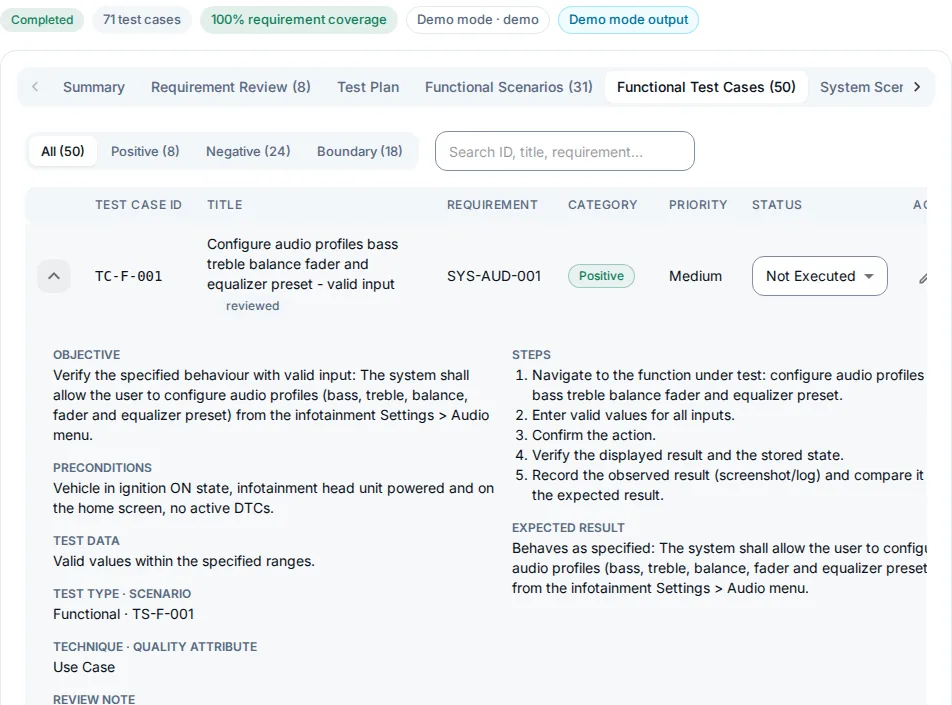
From requirements to test cases: what goes in and what you get
An AI test case generator for hardware and embedded requirements: it generates functional, system and non-functional test cases from your requirements, with requirements traceability and a coverage report.
What goes in
- Functional or system requirements, user stories, feature or design documents
- Type or paste them, or upload TXT, MD, PDF, DOCX or CSV
- A domain (Automotive Electronics, Aerospace & Defence, Medical Devices, Industrial Electronics, Telecom & Networking, Embedded Systems and more) and optional extra instructions
What you get
- Requirement summary, a structured requirement model and a requirement review with a testability score
- A test plan, functional and system scenarios, and functional, system and non-functional test cases
- A traceability matrix and a coverage report, editable in the browser
Exports: Excel, PDF and JSON
Add your own standards (ISO 26262, ASPICE, DO-178C, company test guidelines) to the Knowledge Base and they guide the results.
Free trial: 7 days, 1 full run a day in total across the three apps. For full access, contact sales for a Custom Pass.
What engineers use it for
- Write the first system test specification of a new ECU, gateway or controller from its requirement document
- Add negative and boundary cases to an existing functional test set
- Show which requirements are still untested before a design review or a release
- Follow ISO 26262, ASPICE, DO-178C or your own test guidelines through the Knowledge Base
Who it is for
Test engineers
Start from generated positive, negative and boundary test cases instead of a blank sheet, then review and edit them.
System validation engineers
Get system scenarios and system test cases traced to each requirement, with what is still not covered.
Functional validation engineers
Get functional scenarios and functional test cases for every requirement, with a coverage report.
Embedded systems engineers
Turn the requirements of an embedded product into tests that follow the standards you add, such as ISO 26262 or DO-178C.
Where it helps today
Your data and your engineering judgement
- Private to your accountProjects and knowledge-base documents are visible only to you, enforced by the server and again by row-level security in the database.
- Not used to train modelsMithraTiny does not train models on your content, and Microsoft's terms for Azure OpenAI do not allow it either.
- Results you can checkEvery result shows its reasoning and its risks. Verify it against datasheets and standards before you use it.
More on the security page and in the privacy policy.
Guides and templates
Frequently asked questions
What can I give the Test Case Generator Agent?+
Functional or system requirements, user stories, feature or design documents: typed, pasted or uploaded as TXT, MD, PDF, DOCX or CSV, together with a domain such as Automotive Electronics, Aerospace & Defence, Medical Devices, Industrial Electronics, Telecom & Networking or Embedded Systems.
Which test cases does it generate?+
A test plan, functional and system scenarios, and functional, system and non-functional test cases with positive, negative and boundary cases. It also reviews the requirements and gives each a testability score.
How does it show requirements traceability?+
A traceability matrix links every requirement to its test cases, and a coverage report shows what is not covered yet. Both are updated when you edit or delete test cases in the browser.
Can it follow our standards and test guidelines?+
Yes. Add documents such as ISO 26262, ASPICE, DO-178C or your company's test guidelines to the Knowledge Base, filed by category, and the most relevant passages are used in every run.
Which export formats are available?+
Excel, PDF and JSON.
Can I use the Excel export as a test case template?+
Yes. The workbook has a sheet for the requirements, the scenarios, the functional, system and non-functional test cases and the traceability matrix. Every test case row has its test case ID, title, requirement reference, test type, category (positive, negative or boundary), priority, objective, preconditions, test data, steps, expected result and status, ready to edit for your hardware or embedded project.
Does it write system validation test cases?+
Yes. Besides the functional test cases it writes system scenarios and system test cases, each traced to its requirements, so system and functional validation engineers see which requirements are covered. It writes the tests but does not run them: you execute them and record Pass, Fail or Blocked in the Status column.
Which domains does it support?+
Automotive Electronics, Aerospace & Defence, Medical Devices, Industrial Electronics, Consumer Electronics, Telecom & Networking, IoT & Wearables, Power Electronics, Computing & Storage, Robotics & Motion Control, Embedded Systems and Other. The test cases adapt to the domain you choose.
Is my data used to train AI models?+
No. MithraTiny does not use your content to train models, and under Microsoft's terms for Azure OpenAI the prompts and results are not used to train its models either. Your projects stay private to your account.
Do I need to set up an AI service?+
No. The AI is included: MithraTiny runs it for all three apps, so there is no model to choose and nothing to configure.
Does it replace an engineering review?+
No. The results are a checked starting point that shows its reasoning. Verify every design, calculation and test against the official datasheets, standards and your own review before you use it.
The other MithraTiny AI apps
Compare all three on the features page, or see the passes on the pricing page.
Put an AI Engineer on your next board
Where Engineering Meets Super Intelligence. Free to start, AI included.